


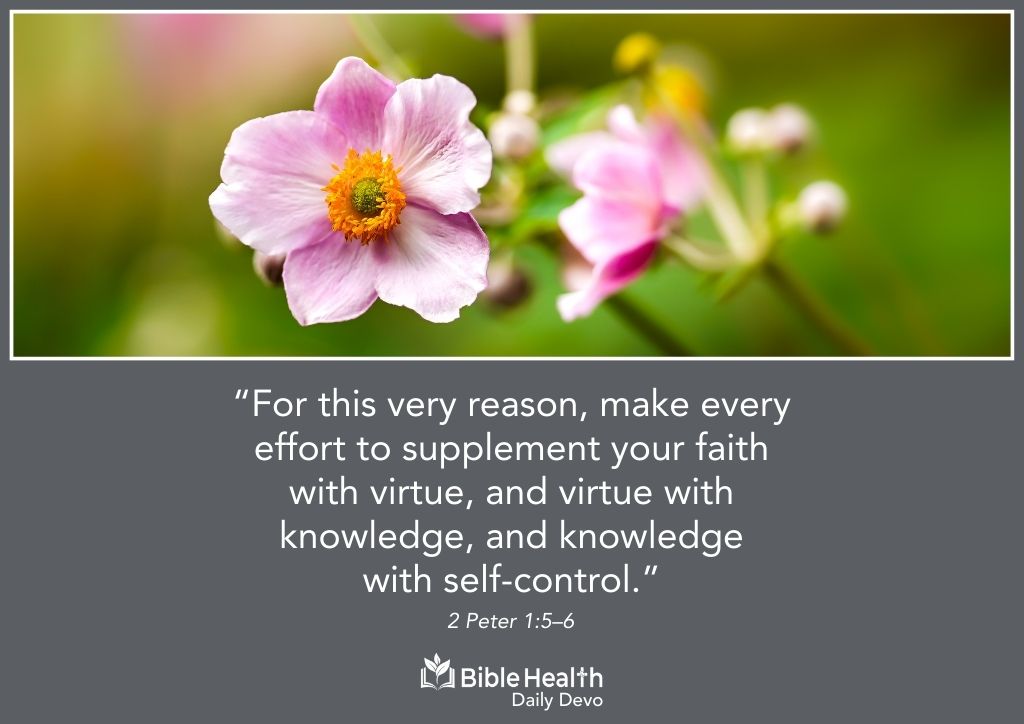


~ 2 Peter 1:5–6
Subscribe to this podcast on iTunes | Spotify
Peter wrote his second letter with urgency. He knew his time was short, and he wanted believers to understand that spiritual growth does not happen accidentally. Faith is the starting point, not the finish line. What follows faith is formation. Peter describes growth as something built deliberately, layer by layer, with intention and effort.
Self-control sits in the middle of this progression for a reason. It connects what we know with how we live. Knowledge without restraint becomes pride or excess. Faith without self-control becomes inconsistent. Peter understood that desire must be governed if belief is to mature into stability. Self-control is not optional seasoning. It is structural.
This passage speaks clearly into Biblical health.
Self-control is learned, not assumed. Peter does not say it appears automatically with faith. He says it must be added. That language implies practice, repetition, and patience. When self-control is neglected, desire fills the gap. Over time, that leads to imbalance, distraction, and fatigue. God does not cause disorder, but untrained desire often produces it quietly.
Peter’s call to “make every effort” is not about striving for worthiness. It is about participation. Growth requires cooperation. Self-control develops when choices are made consistently, even when no one is watching. These choices shape the body and mind over time, reinforcing patterns that either support life or slowly undermine it.
This matters because many people expect clarity without discipline. Peter offers a different framework. Knowledge must be paired with restraint to be useful. Without self-control, insight does not translate into wisdom. With self-control, understanding becomes embodied. Honoring God with our health flows naturally from this alignment because the body becomes a participant in faith rather than a competing voice.
Peter also places self-control before steadfastness. That order matters. Endurance is difficult when impulses rule. Restraint creates the conditions for perseverance. When appetite, emotion, or urgency no longer dictate decisions, life becomes steadier. Self-control does not eliminate desire. It orders it so that growth can continue without collapse.
This progression also guards against stagnation. Peter later warns that those who fail to grow become nearsighted and forgetful. Self-control protects memory and direction. It keeps faith from becoming abstract and grounds it in daily practice. Biblical health grows where restraint supports clarity and purpose.
Peter’s message is hopeful. Growth is possible. No one is stuck. Self-control can be added, strengthened, and refined over time. Each restrained choice builds capacity for the next. Over time, discipline becomes less effortful and more natural.
Biblical health is not about perfection. It is about participation. When we intentionally add self-control to faith, life becomes more coherent and faithful. Peter reminds us that maturity is built, not wished for.
Prayer: Father, help me participate in the growth You desire for my life. Teach me to add self-control with patience and wisdom. Guide my choices so restraint strengthens my faith rather than burdening it. Shape my habits so they support clarity, endurance, and obedience, honoring You with the life You have entrusted to me. Amen.